

1. The Great Force-Field Scam: Why You Are Technically Levitating
We all grew up with that lovely high-school science drawing of an atom: a neat little cluster of balls in the middle (the nucleus) with electrons orbiting around it like miniature planets. It's a grand picture. It's also almost completely misleading—a bit like drawing a map of Ireland where Dublin pub prices are "reasonable."
Here is the first inconvenient fact from physics: an atom is almost entirely nothing at all. If you blew up the nucleus of a single atom in your fingertip to the size of a marble and set it on the center spot of Croke Park stadium, the outer electrons wouldn't be sitting next to it. They would be buzzing around like midges out past the top row of the bleachers. Everything in between—99.9999999999996% of the atom—is dead-empty space.
"Grand," you say, "so why doesn't my hand fall straight through the kitchen table when I lean on it?"
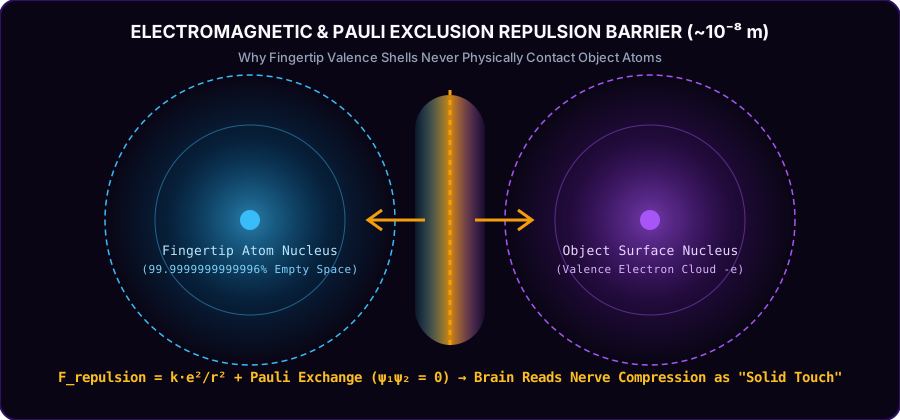
Because of magnetic and electric repulsion. Every atom is wrapped in a shell of negatively charged spinning electrons. When you reach out to pick up a coffee mug, a hammer, or a pint of Guinness, the outer electrons in your fingers get within about a hundred-millionth of a centimeter (10⁻⁸ meters) of the outer electrons in the glass.
The Facts & Research — Why Atoms Refuse to Touch
1. Electromagnetic Repulsion: Just like trying to push the north poles of two magnets together, the negative electron clouds in your skin and the negative electron clouds in the object violently repel each other across the microscopic gap.
2. The Pauli Exclusion Principle (1925): Austrian physicist Wolfgang Pauli won the Nobel Prize for proving that two identical electrons flat-out refuse to occupy the same quantum state at the same time. The closer you shove them, the harder their force fields push back.
So what happens when you "touch" the glass? The glass's invisible force field shoves back against your skin's invisible force field before the atoms ever meet. That invisible shove squashes the nerve endings in your fingers, which fire a tiny electrical zap up your arm to your brain. Your brain—being a dramatic storyteller—translates that electrical zap as: "Ah, yes, solid glass!"
Think about that for a second: you aren't sitting on your chair right now. You are hovering a hundred-millionth of a centimeter above it on an electromagnetic cushion. And if a judge ever asks, no, technically your fist never touched that fella's nose—your atomic force fields merely had a lively disagreement at close range. (Do not try this defense in court.)
Test Why Your Fingers Never Actually Touch Anything
Drag the top slider to push your fingertip atom closer to the atoms in your coffee mug (or pint glass). Watch how the magnetic and electric fields in the outer electron shells panic and shove back harder the closer you get—proving you're technically hovering above everything you own.
2. Frequency & Vibration: Matter Is Just Frozen Music
Now, if we never touch objects because of force fields, what are the electrons and protons themselves made of? Tiny, rock-hard specks of dust?
Not a bit of it. When physicists built giant particle colliders and zoomed in past the atom to look for the "solid stuff" at the bottom of reality, they found... pure frequency and vibration.
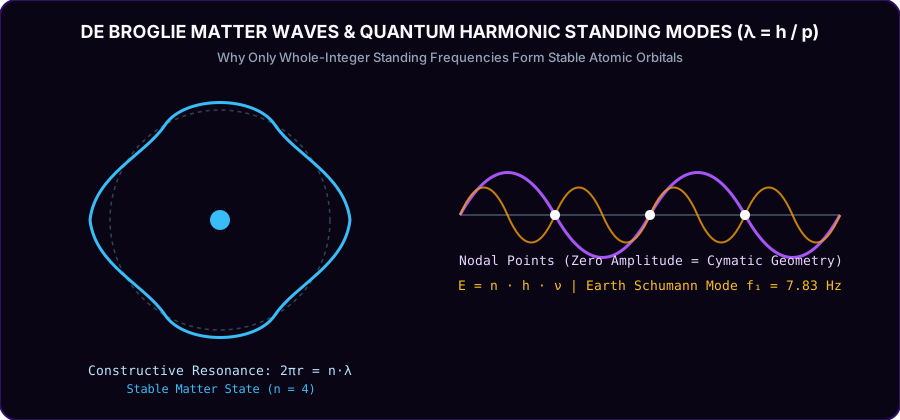
The Facts & Research — Vibration Is the Building Block
Louis de Broglie's Matter Waves (1924): De Broglie proved that all matter—every electron, atom, and molecule—behaves as a vibrating wave with its own frequency and wavelength (λ = h / p).
Where 99% of Your Weight Comes From: In 2008, physicists using supercomputers to solve the equations of Quantum Chromodynamics proved that the actual "particles" (quarks) inside protons and neutrons make up less than 1% of your body's mass. The other 99% of your weight is pure vibrational energy buzzing at the speed of light inside your atoms. Next time you step on the bathroom scale after Christmas, don't blame the potatoes—tell yourself you're just "high-frequency."
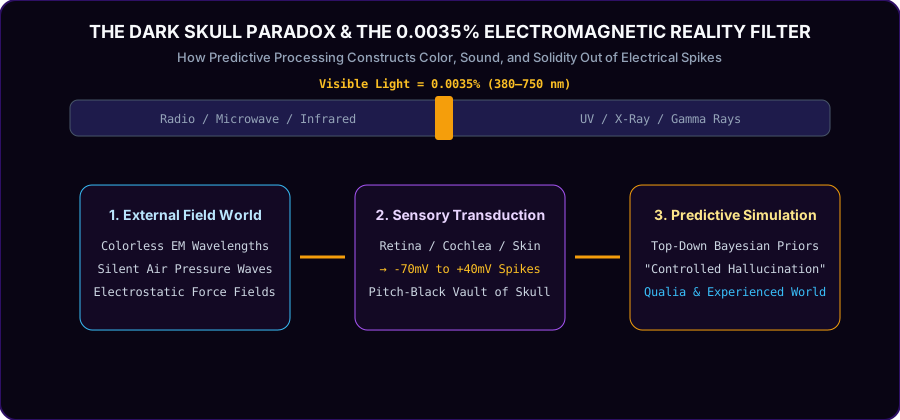
3. The Pitch-Black Skull: We're All Just Guessing
Here is the final kicker to mull over: inside your skull, it is completely dark and dead silent.
No sunlight ever reaches your brain. No sound waves ever enter your head. Your eyes only detect a tiny sliver—0.0035%—of the electromagnetic spectrum, completely blind to the radio waves, Wi-Fi signals, infrared, ultraviolet, and cosmic rays flying through your living room right now. Your ears, eyes, and skin simply convert vibrations into tiny electrical clicks, and your brain sits in the dark, stitching those clicks together into a full-color movie it calls "reality."
"So let's recap: Your fingers have never actually touched a single object you own because atomic magnetic fields shove you away at the last second. Ninety-nine percent of your body weight is just vibrating energy in empty space, and your eyes are blind to 99.9965% of the light in the universe. Given how little we actually understand about the world right in front of our noses... what else are you dead certain is true that's really just another thin white lie?"
The Receipts (Real Science & Research Sources)
1. Wolfgang Pauli (1925): Exclusion Principle — proving why electrons refuse to share the same quantum space and create the repulsive force we feel as "touch."
2. Louis de Broglie (1924): Wave Nature of Matter — Nobel Prize discovery proving all matter vibrates with a wavelength and frequency.
3. Dürr et al. (2008), Science: Supercomputer proof that 99% of the mass of protons and neutrons comes from vibrating field energy, not solid particles.